
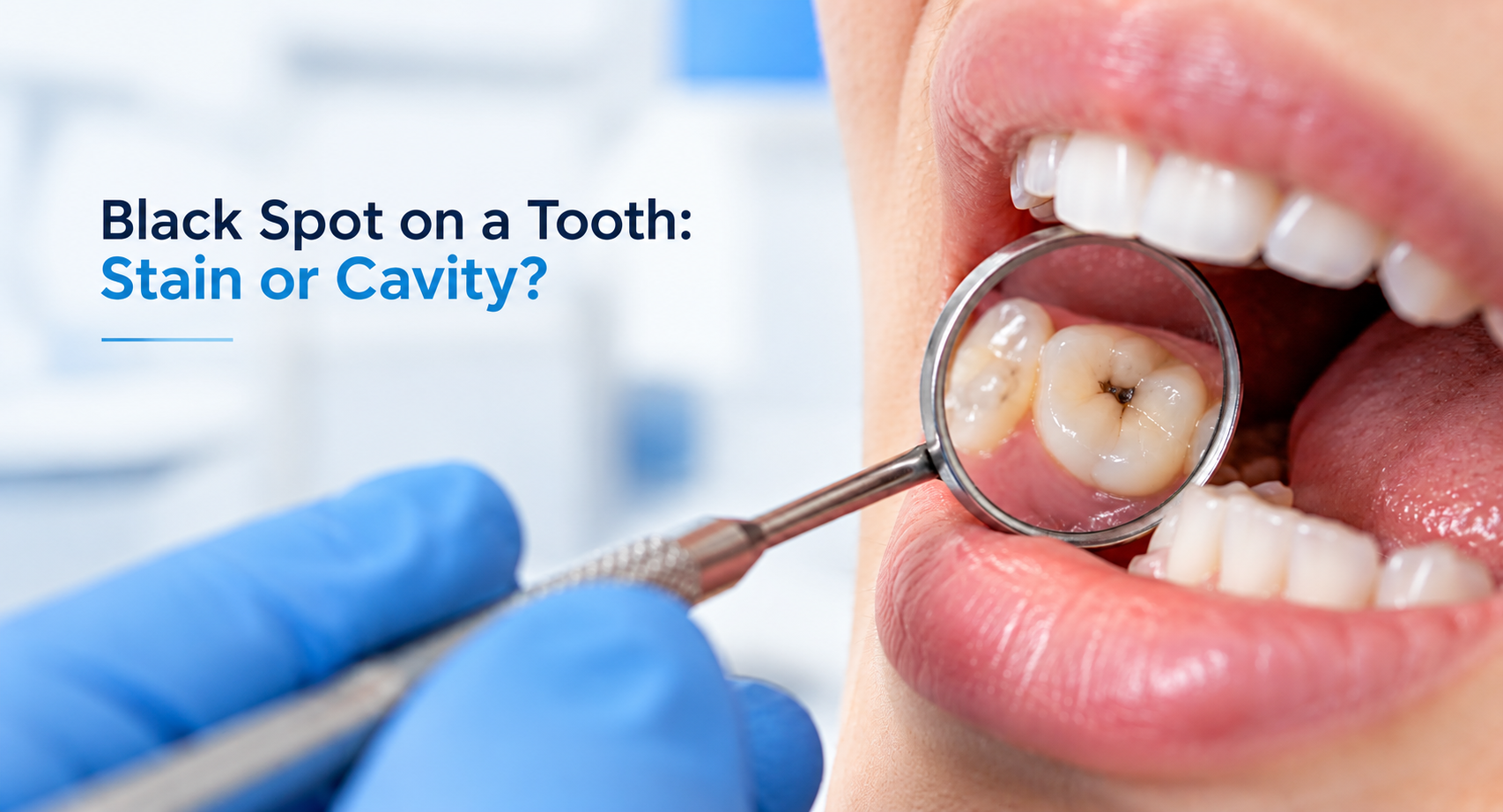

A black spot on a tooth can be a harmless stain or an early cavity. You cannot always tell by looking, and pain is a poor guide.
A stain sits on the surface and feels smooth under your tongue. A cavity is a hole or soft spot that feels rough, sticky, or pitted.
Early decay rarely hurts, so a painless black spot can still be a cavity. Our post on a painless hole in a tooth shows why silent decay is common.
Black Spot on Tooth: Stain or Cavity? The Quick Test
Check texture, location, change over time, and sensitivity to tell them apart. This table shows how a stain and a cavity usually differ.
| Feature | Stain | Cavity |
| Texture | Smooth | Rough, sticky, or pitted |
| Location | Surface, often near the gum line | Grooves, pits, and between teeth |
| Change | Stays the same | Grows or darkens |
| Sensitivity | Usually none | Sweets, cold, or biting |
| Fix | Professional cleaning | Filling |
According to Cleveland Clinic, decay starts chalky white, then turns brown and finally black. If the black spot feels rough, decay may be past the early stage.
Cavity vs Stain: What a Dentist Looks For
Cavity vs stain is a question of structure, not color alone. Stains sit on top of healthy enamel, while cavities break the enamel itself.
Color helps less than you would expect, because both can look brown or black. A dentist compares hardness, shape, and X ray shadows before naming the cause.
A stain itself does not turn into a cavity, but plaque around it can. Poor cleaning lets both stain and decay develop side by side.
What Do the Colors Mean?
Color gives a clue, but it never gives a diagnosis. Use it to decide how urgent your visit should be.
| Color | What It May Mean |
| Chalky white | Early mineral loss, often reversible with fluoride |
| Light brown | Enamel decay or a surface stain |
| Dark brown | Decay reaching dentin, or a heavy stain |
| Black | Advanced decay, tartar, an old filling, or black stain |
What Causes a Dark Spot on a Tooth?
Black spots on teeth come from surface stains, decay, old dental work, or tartar. Here is how to recognize each one, starting with the most harmless.
Surface Stains
Coffee, tea, red wine, and tobacco leave dark films that brush cannot fully remove. These stains are smooth and do not damage the tooth.
Chromogenic Bacteria
Some bacteria leave thin black lines near the gum line, mostly in children. A 2025 meta analysis linked black stain to lower cavity odds in children. The authors warn against drawing clinical conclusions from that result. The pooled prevalence of black stain across those studies was 9.4 percent.
Tooth Decay
Decay starts when bacteria turn sugar into acid that dissolves enamel. Left alone, the spot darkens as the damage reaches the softer dentin.
Old Fillings and Silver Diamine Fluoride
Silver fillings can darken a tooth from within over the years. Silver diamine fluoride, or SDF, arrests decay but leaves permanent black staining, per the ADA. The Illinois Department of Public Health reports 81 to 89 percent success stopping cavity progression.
Tartar
Tartar is hardened plaque, and it can turn brown or black near the gums. Only a professional cleaning can safely remove tartar once it hardens.
Fluorosis, tetracycline use in childhood, injury, and some conditions can also darken teeth.
Black Spot on Tooth, No Pain: Is It Still a Cavity?
Yes, a painless black spot can still be a cavity. Enamel has no nerve endings, so early decay often stays silent.
Pain usually starts after decay reaches dentin or the nerve. By then, a simple filling may no longer be enough.
Treat it as a possible cavity if you notice any of these:
- The spot feels rough, soft, or sticky
- It has grown or darkened over the past few weeks
- Sweets or cold drinks cause a twinge
- Food keeps catching in the same spot
- A visible pit or hole has formed
If none apply, it may be a stain, but only an exam can confirm.
Black Spot Between Teeth: Why It Is Harder to Judge
A black spot between teeth is hard to see, and cavities hide there easily. Floss and brushing miss these tight contact points, so plaque builds up. Floss once a day, and sweep the floss against each tooth in a C shape.
Dentists use X rays to find decay you cannot see. Bitewing X rays show the spaces between your back teeth clearly. A shadow on the side of a tooth deserves prompt attention. Food that keeps catching in one gap is another warning sign.
Black Dot on Tooth: What to Do Next
Follow these steps when you first notice a black dot on a tooth:
- Run your tongue over the spot and note whether it feels smooth or rough.
- Brush gently and floss around it for a few days, then look again.
- Take a clear photo in good light so you can track changes.
- Skip lemon juice, baking soda scrubs, and harsh whitening on the spot.
- Book an exam even if it looks stable, since only imaging confirms decay.
Any dark spot on tooth surfaces that changes shape or color deserves a quick exam. Never scrape a dark spot with a pick or pin at home. You can damage healthy enamel and push bacteria deeper into the tooth.
Two Examples: Same Color, Different Answers
Picture a dark dot in the groove of a back molar. It feels sticky under a probe, and the X ray shows a shadow beneath it. That tooth needs a small filling now, before the decay reaches the nerve.
Now picture a flat brown line near the gum that feels smooth and never changes. That one likely needs only a cleaning and a regular recheck.
How We Tell a Stain From a Cavity at Lincolnwood Family Dental
We use the same four step process for every dark spot.
- We dry the tooth and inspect the spot under bright light.
- We gently check the texture with a dental probe.
- We take digital X rays to look for decay under the surface.
- We explain what we see and outline your treatment options.
Our CT Orthophos SL adds a 3D view when regular X rays fall short. If decay reaches the nerve, endodontist Dr. Ameena Haroon treats it in our office. Same day CEREC crowns often let us restore a badly damaged tooth in one visit.
An adult exam costs $89, or $19 if you are in pain. Patients have left more than 700 five star reviews for our team. We were also ranked first in Lincolnwood as of August 2025.
Treatment: What Each Dark Spot Needs
Surface stains and tartar come off during a professional cleaning and polish. Fluoride can reverse the earliest stage of decay, before a cavity forms.
| Finding | Typical Treatment |
| Surface stain | Cleaning and polish |
| Tartar | Scaling |
| Early decay, white or light brown | Fluoride and monitoring |
| Cavity in enamel or dentin | Tooth colored filling |
| Decay reaching the nerve | Root canal, then a crown |
A stain needs only a cleaning, while a cavity needs a filling. Our guide explains when you need a dental filling and which materials work.
If a tooth throbs, our list of signs you need a root canal helps.
Can You Prevent Dark Spots on Teeth?
Brush twice a day with fluoride toothpaste and clean between teeth daily. Our toothpaste guide for cavities, sensitivity, and gum health can help you choose.
Limit sipping on coffee or soda all day, since constant acid exposure weakens enamel. Rinse with water after dark drinks, and visit us for cleanings every six months.
When a Black Spot Becomes an Emergency
Call the same day if a dark spot comes with swelling, fever, or throbbing pain. Those signs can point to an abscess, which can spread if untreated.
Our guide to tooth abscess symptoms explains the warning signs in detail. Our emergency dentist team prioritizes patients who are in pain.
Frequently Asked Questions
Can a black spot on a tooth go away on its own? A light surface stain may fade with better brushing or a cleaning. Decay never heals on its own once a hole has formed. Have any spot that lasts more than a few weeks checked.
Are black spots on baby teeth different? Black stain is common in children and is often harmless, but cavities look similar. A dental exam confirms which one it is, so do not guess at home.
Does a black spot always need a filling? No, a stain needs only a cleaning and early decay may need only fluoride. A filling is needed once the enamel has broken into a true cavity.
Can whitening remove a black spot? Whitening works on surface stains but not on decay or internal discoloration. Bleaching a cavity can also irritate the tooth and hide a growing problem.
Why is my whole tooth turning dark? A tooth can darken after an injury or root canal when inner tissue breaks down. A gray or black tooth with no visible spot needs an exam for infection.
Not sure if your spot is a stain or a cavity? Book an exam and we will tell you for certain.