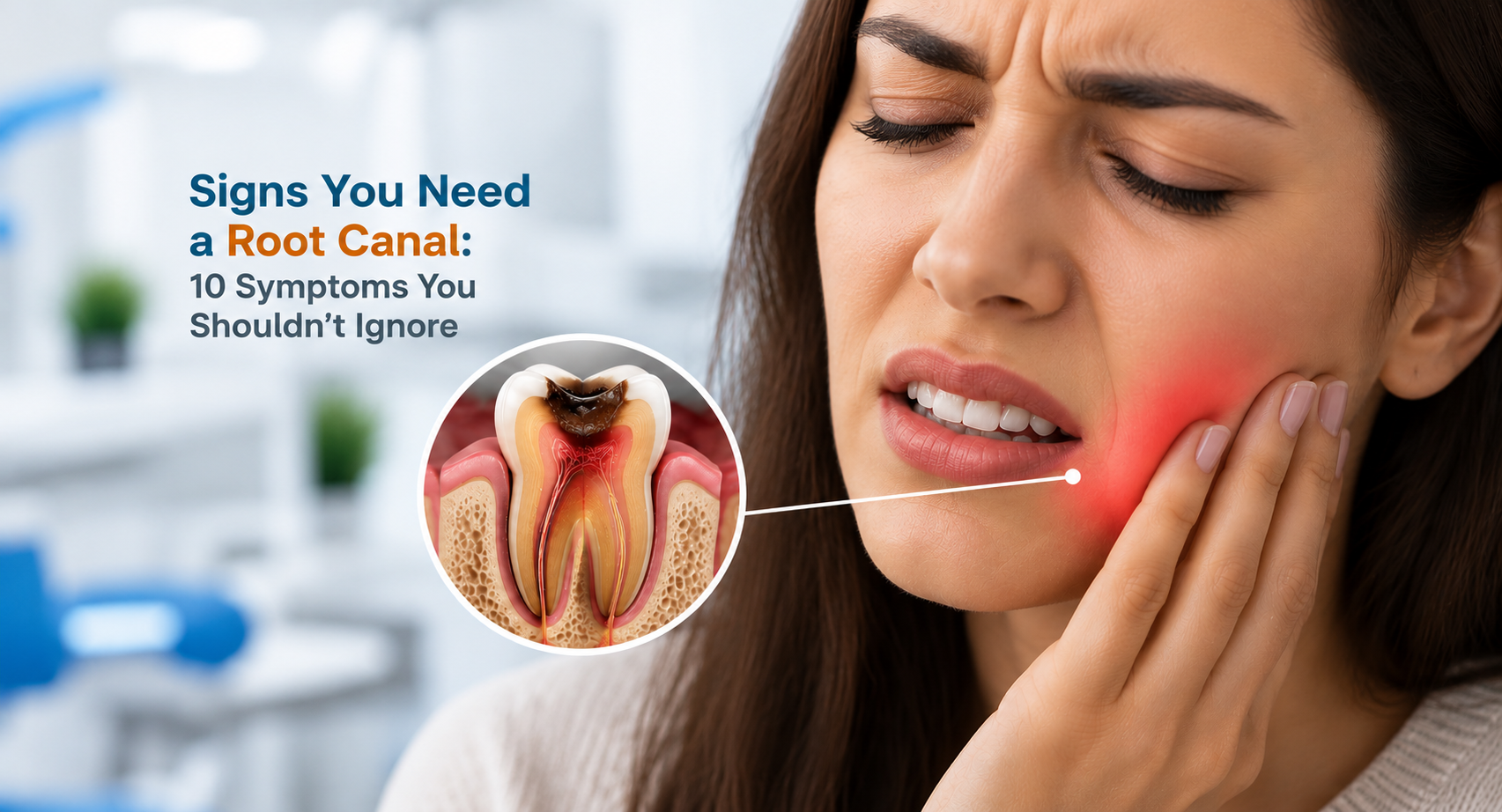

Root canal treatment removes infected or inflamed pulp from inside a tooth, cleans and disinfects the canals, and seals them to prevent reinfection. The clearest signs you need a root canal are spontaneous throbbing pain, sensitivity to hot or cold that lingers longer than 30 seconds after the stimulus is removed, a darkened tooth, and swelling or a pus-draining bump on the gum. A peer-reviewed clinical study found that patients with irreversible pulpitis reported severe pain to temperature changes, spontaneous pain, referred pain, and throbbing that woke them at night, a symptom profile that distinguished them from patients whose pulp could still heal.
Key Takeaways
- More than 15 million root canals are performed each year in the United States, and tooth survival after treatment ranges from 86% to 93% over two to ten years.
- The clinical threshold is the 30-second rule: sensitivity that fades within 30 seconds suggests reversible inflammation, while pain that lingers beyond 30 seconds points to irreversible pulpitis.
- Spontaneous pain, especially pain that wakes you at night, is a hallmark of nerve damage that will not heal on its own.
- A tooth turning gray or dark signals internal tissue breakdown, even when pain is absent.
- Only 17% of patients in one review described root canal treatment as their most painful dental experience, suggesting the symptoms are usually worse than the procedure itself.
- Symptom persistence or infection recurrence occurs in about 10% to 15% of treated cases.
What causes root canals?
A root canal becomes necessary when bacteria invade the pulp, the soft tissue of nerves and blood vessels inside the tooth. The American Association of Endodontists lists the main causes as deep decay, repeated dental procedures on the same tooth, faulty crowns, and a crack or chip. Trauma to the tooth can also damage the pulp even when the tooth looks intact on the outside.
The biological mechanism matters. Bacteria from a deep cavity or crack trigger inflammation inside the rigid walls of the tooth. Because the pulp sits in a hard, enclosed chamber, the swelling has nowhere to expand, which compresses the blood supply and accelerates nerve death. A peer-reviewed pathology study confirmed that irreversible pulpitis patients experienced pain that was difficult to control with painkillers, because the inflammation has passed the point where the tissue can recover.
In most cases, root canals result from bacterial invasion through decay or a crack, but repeated dental procedures on the same tooth, and even trauma without a visible break, can do the same.
10 signs you need a root canal
These are the root canal signs and symptoms clinicians look for. Any one is a reason to call your dentist. Several together raise the urgency.
1. Pain that lingers more than 30 seconds after hot or cold. This is the single most cited diagnostic marker. Cleveland Clinic lists lingering sensitivity as a key indicator that the pulp may be infected. In clinical diagnosis, pain from a cold test that subsides within 30 seconds suggests a reversible problem; pain that persists beyond 30 seconds indicates the nerve is likely too damaged to heal.
2. Spontaneous, unprovoked pain. Pain that starts on its own, without eating, drinking, or touching the tooth, signals the nerve is actively dying. Researchers describe spontaneous pain as a hallmark of irreversible pulpitis, noting it can progress into continuous, intensified pain that worsens during sleep.
3. Pain that wakes you at night. Nighttime throbbing is a red flag. The clinical literature consistently associates pain that disrupts sleep with advanced pulp inflammation, because lying flat increases blood flow to the head and raises pressure inside the already swollen pulp chamber.
4. A tooth that has darkened or turned gray. Discoloration happens when the pulp tissue breaks down internally. Healthline explains that trauma or internal tissue breakdown can damage the roots and give the tooth a grayish-black appearance. Even without pain, a color change is one of the signs a root canal is needed.
5. Swollen, tender gums next to the tooth. Gum swelling localized to one tooth, especially when the tissue feels warm or puffy, points to infection draining from the root tip. Cleveland Clinic includes swollen gums in its root canal symptom list.
6. A gum boil or pimple that oozes pus. A small bump on the gum near the affected tooth, called a fistula, forms when an abscess creates a drainage channel. The pus can produce a bad taste and foul breath.
7. Sharp pain when biting or pressing on the tooth. Percussion sensitivity means the infection or inflammation has spread beyond the root tip into the surrounding ligament and bone.
8. A cracked or chipped tooth with deep pain. A crack that reaches the pulp allows bacteria to enter the nerve chamber directly. The AAE lists cracks and chips among the primary causes of pulp damage. This is one of the signs a root canal is needed even without classic throbbing, because the crack may be too small to see but deep enough to reach the nerve.
9. A tooth that feels noticeably loose. An abscess at the root tip can soften the surrounding bone, making the tooth mobile. Cleveland Clinic notes a loose tooth as one of the root canal signs and symptoms indicating that the infection is affecting the nearby bone.
10. Facial swelling, jaw swelling, or fever alongside tooth pain. Systemic symptoms signal the infection is spreading. This is an emergency: the bacteria can move into the jaw, neck, or bloodstream.
How to know I need a root canal versus a filling
The distinction sits at the nerve. A cavity that has not reached the pulp is treated with a filling. A crack confined to the enamel may only need a dental crown. Sensitivity from worn enamel is managed with a preventive care visit.
Root canal treatment comes into play when the damage extends into the pulp. A dentist confirms this with X-rays, a vitality test (applying cold or a small electric current), and percussion. How to know I need a root canal at home comes down to watching for the pattern: pain that lingers beyond 30 seconds, throbs on its own, or wakes you up is the signal to call, because a filling cannot fix an infected nerve.
What happens during root canal treatment, and does it hurt?
The AAE reports that more than 15 million teeth are treated and saved with root canal treatment each year, and a review of 72 studies found that only 17% of patients described it as their most painful dental experience. The symptoms you need a root canal to fix are almost always worse than the procedure itself.
Your dentist or endodontist numbs the tooth, isolates it with a protective sheet, removes the infected pulp, cleans and shapes the canals, fills them with a biocompatible material, and seals the tooth. A crown is usually placed afterward to restore strength. An NCBI systematic review found that tooth survival over two to ten years after initial root canal treatment ranged from 86% to 93%, with symptom persistence or reinfection occurring in about 10% to 15% of cases.
At Lincolnwood Family Dental, a women-led practice ranked number one in Lincolnwood for August 2025 with more than 700 five-star reviews, root canal treatment is handled by Dr. Ameena Haroon, the practice’s on-staff endodontist. Having a specialist in-house means no referral to a separate office. If the tooth needs a crown afterward, the in-house CEREC system can produce a same-day crown in one visit. If the pain is severe, emergency dental care is also available. A general dentistry exam is where diagnosis starts, and you can book online or call 847-610-9272.
Frequently Asked Questions
How do I know if I need a root canal or just a filling?
The 30-second threshold is the key clinical marker. Pain from cold that fades within 30 seconds usually means the pulp can still heal and a filling may be enough. Pain that lingers beyond 30 seconds, throbs spontaneously, or wakes you at night points to irreversible pulpitis, which requires root canal treatment.
Can a tooth that needs a root canal heal on its own?
No. Once pulp inflammation passes the irreversible stage, the tissue cannot repair itself. Without treatment, the infection spreads to the bone and forms an abscess. Delaying treatment converts a saveable tooth into one that may need extraction.
What happens if I ignore root canal signs and symptoms?
The infection can spread to the jawbone, form an abscess, damage neighboring teeth, and in rare cases enter the bloodstream. Early root canal treatment saves the tooth and prevents more complex, costly procedures.
This article is for general information and is not a substitute for professional dental advice. If you notice any of these symptoms, see a dentist for evaluation.