
Raise your hand if you’ve ever bitten your cheek, watched a sore show up two days later, and then spent the next week poking at it with your tongue wondering if it’s “normal.” Weird how it’s universal, and most of us have been annoyed at least once by a little white-and-red sore on the inside of our cheeks that makes eating pizza feel like a personal attack.
Nine times out of ten, it’s a harmless canker sore, and it’ll be gone before you even remember to mention it at your next dental visit. But dentists actually worry about the tenth time: the one unusual sore that shows up at the worst possible time, sticks around, doesn’t hurt the way it should, or just feels “off” somehow. Most of us have had one. Most of us have also Googled “canker sore vs oral cancer” at 1 a.m., half-convinced it’s the worst.
We’re writing this to help you understand when to worry about a canker sore, because most people genuinely don’t know where the line is between “give it a few more days” and “call the dentist.”
What Exactly Is a Canker Sore? You Probably Have This
Most mouth ulcers are canker sores; dentists call them aphthous ulcers. Nothing dramatic; it’s just a small, shallow sore that shows up on the soft tissue inside your mouth: usually on the inner cheeks, lips, tongue, or along the base of the gums.
One easy way to rule out a cold sore, which is a completely different (and contagious) condition caused by the herpes simplex virus is that a canker sore forms inside the mouth, never on the outside of the lips, and never anywhere near the skin.
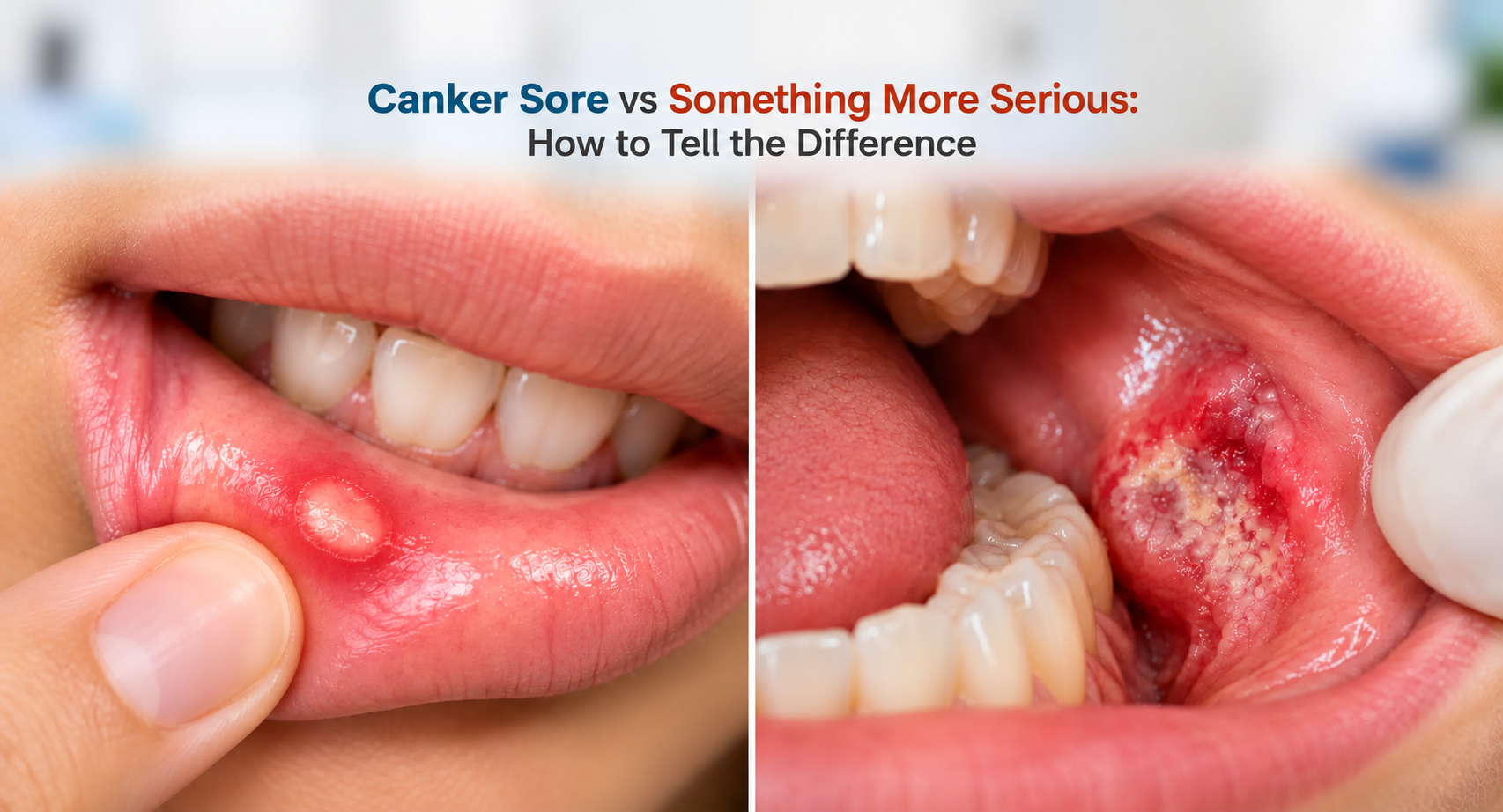
According to the National Institute of Dental and Craniofacial Research (NIDCR), a typical canker sore is small, round or oval, with a yellow or white center and an angry-looking red rim around it. It usually hurts almost immediately; sometimes there’s even a tingling warning sign a day before it actually appears. And then, without doing anything special, it heals on its own within one to two weeks.
Canker sore symptoms typically include:
- Round or oval sore with a white or yellow center and a red halo
- Burning or tingling sensation a day or two before the sore appears
- Pain while eating, drinking, brushing, or talking
- Mild swelling around the sore
- One to several sores appearing at the same time
Canker sores are self-limiting. Minor ones usually clear up within 7 to 14 days without leaving a scar, even without treatment.
What Causes Mouth Ulcers?
NIDCR is upfront that the exact cause of canker sores remains unknown. Still, several common triggers show up again and again, such as:
- Minor mouth injury: accidentally biting your cheek, aggressive brushing, or a sharp edge on a filling or braces
- Acidic or spicy foods: citrus fruits, tomatoes, coffee, and chocolate are common irritants
- Nutritional deficiencies: low levels of vitamin B-12, zinc, folic acid, or iron
- Emotional stress or lack of sleep: stress is known to weaken the immune response
- Toothpaste ingredients: sodium lauryl sulphate (SLS), a foaming agent found in a lot of everyday toothpaste has been linked to recurrent sores in some people
- Hormonal changes: many women notice sores linked to their menstrual cycle
- Underlying conditions: in rare cases, recurrent ulcers can be linked to coeliac disease, inflammatory bowel disease, or a weakened immune system
If your ulcers are recurring frequently, it’s worth mentioning to your dentist. Recurrent sores can sometimes point to something fixable, like a diet gap, a toothpaste swap, or a habit that’s easy to correct once you know what to look for. Our General Dentistry team looks for these patterns during routine visits.
Difference Between Canker Sore vs Oral Cancer: The 2-Week Rule
Remember this: give any mouth sore two weeks, that’s the window dentists and researchers consistently point to. Within two weeks, healing is the expected outcome. Past two weeks with no real improvement, it’s time to get it looked at.
| Factors | Ordinary Canker Sore | Possible Warning Sign of Oral Cancer |
| Pain | Usually painful from day one | Often painless at first, easy to ignore |
| Shape | Round/oval, neat, well-defined border | Irregular, ragged edges |
| Timeline | Gone in 7–14 days | Lingers past 3 weeks, may grow |
| Bleeding | Rare, no obvious cause | Can bleed with little or no trigger |
| Texture | Soft, shallow | May feel like a lump or thickened patch |
| Pattern | Comes and goes, heals each time | Doesn’t resolve; may keep expanding |
Nothing on the right side of that table is an automatic cancer diagnosis. Infections, denture irritation, and conditions like oral lichen planus can look similar; it is your cue to stop waiting and start asking.
Canker Sore Not Healing? Here’s When to Worry
Oral cancer symptoms can be subtle, and that’s precisely what makes them dangerous. According to the American Dental Association (ADA), squamous cell carcinoma accounts for roughly 90% of all cancers of the mouth and throat. While a little patience is fine for the first week or two, you should book an appointment if you notice any of the following:
- Sore has lasted longer than 2–3 weeks, and it’s growing larger
- Keeps coming back in the exact same spot repeatedly
- Red/white patch on the gums, tongue, tonsils, or the lining of the mouth
- Lump, thickening of the cheek that you can feel from inside or outside
- Persistent difficulty chewing, swallowing, or moving the jaw or tongue
- Unexplained bleeding, numbness, or feeling that something is caught in the throat
- Loosening of teeth with no obvious dental cause
- Chronic hoarseness or a change in voice
- Persistent earache on one side, unrelated to an ear infection
Major risk factors include tobacco use, heavy alcohol consumption, chewing betel quid, or Human papillomavirus (HPV) exposure. None of these symptoms automatically mean cancer, but they do mean it’s time for a professional opinion rather than another week of “let’s see if it goes away.”
A 60-Second Mouth Check You Can Do
Dentists use a structured head-and-neck exam, but there’s a simplified version you can do yourself in the bathroom mirror, and it takes less time than brushing your teeth:
- Look at your lips and gums inside out, in good light for any patches, color changes, or sores.
- Pull your cheek out gently and check the inside lining for white, red, or dark patches.
- Stick your tongue out and examine the top and sides, and lift it and check underneath.
- Tilt your head back and look at the roof of your mouth.
- Run two fingers along your jaw and neck, feeling for any lump or swelling that wasn’t there before.
If anything looks unusual or feels different from last month, note it down and keep an eye on it. Self-check is a great habit, but it’s a supplement to professional screening, not a replacement for one.
Oral Cancer Statistics You Should Know
Numbers rarely lie, and these highlight exactly why regular screening matters:
- NIDCR reports that approximately 58,000 Americans are diagnosed with oral cancer each year, resulting in around 12,000 deaths.
- NIDCR data also shows that in 2022, roughly 307,336 men and 144,738 women in the U.S. were living with oral cancer, with prevalence rising sharply after age 50.
- According to the ADA, the American Cancer Society estimates that oral cavity and pharynx cancers will account for 60,480 new cases and 13,150 deaths in the U.S. in 2026, about 2.9% of all cancer diagnoses and 2.1% of all cancer deaths that year.
- Encouragingly, survival odds improve dramatically with early detection: cancers caught at Stage 1 or 2 have a five-year survival rate of 70–90%, compared to far lower odds when diagnosis is delayed.
How Lincolnwood Family Dental Can Help You Stay Safe
At Lincolnwood Family Dental, you don’t need to book a separate, scary appointment for oral cancer screening. Our routine check-up under Preventive Dentistry includes it as standard. While you’re in the chair, our dentists are visually and physically screening your lips, cheeks, gums, tongue, and the floor of your mouth. If your discomfort is severe or sudden, and that feels urgent, our Emergency Dentist team can usually see you the same day.
Our women-led team has cared for the Lincolnwood, Skokie, Evanston, and greater Chicago community for years. We understand that a sore in your mouth can feel scary to bring up. So, we make it easy, comfortable, and judgment-free to ask.
Schedule an appointment with Lincolnwood Family Dental today, and let our team put your mind at ease. Browse more oral health guidance on our Dental Blogs section.
Frequently Asked Questions
How do I know if my mouth ulcer is serious?
Time is the biggest clue. If it heals within two weeks, it’s almost certainly an ordinary canker sore. If it’s still there past three weeks, growing, bleeding, or unusually painless, book a dental exam rather than waiting it out.
What’s the actual difference between a canker sore and a cold sore?
Location and cause. Canker sores form inside the mouth and aren’t contagious. Cold sores form on or around the outer lips, are caused by the herpes simplex virus, and are contagious.
Can stress really cause canker sores?
Yes, it’s one of the most commonly reported triggers. Periods of high stress or poor sleep seem to lower your body’s tolerance for minor mouth irritation, making sores more likely to appear.
Does oral cancer always come with pain?
No, and that’s exactly what makes it tricky. Many early oral cancers are painless, which is why a visual and physical dental screening can catch things that patients often don’t notice on their own.
How often should I get screened for oral cancer?
For most adults, a screening at each routine dental check-up (typically every six months) is sufficient. If you have elevated risk factors like tobacco or alcohol use, your dentist may recommend closer monitoring.