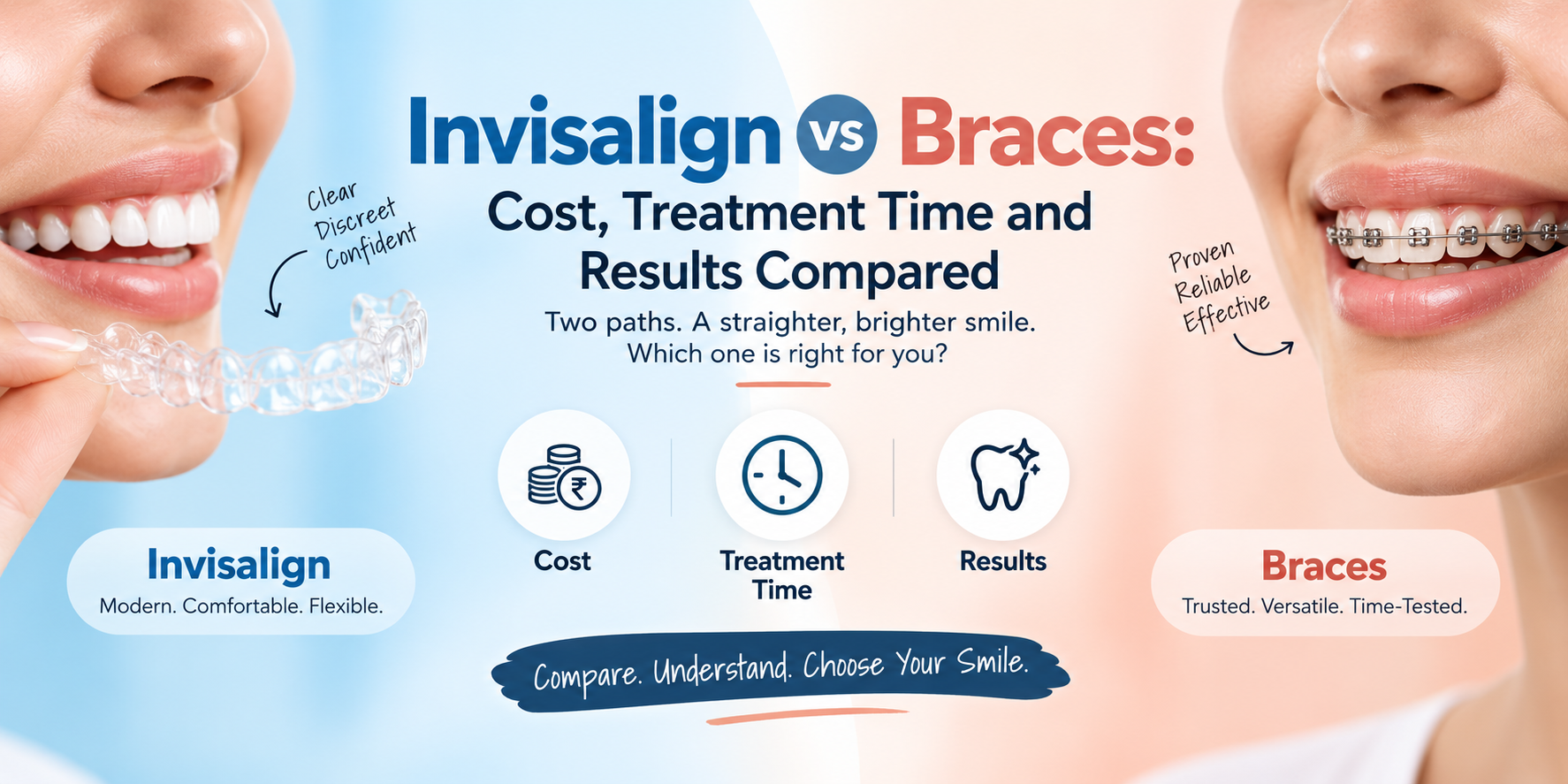

Choose Invisalign if you want faster, nearly invisible treatment for mild to moderate alignment. Choose braces if you have a complex bite that needs strong mechanical control.
Most adults we see at Lincolnwood Family Dental are great Invisalign candidates. But we tell patients upfront when braces would work better for their specific case.
Invisalign vs Braces at a Glance
| Factor | Invisalign | Traditional Braces |
| Typical cost | $3,000 to $8,000 | $3,000 to $7,000 |
| Average treatment time | 18 months | 24 months |
| Visibility | Nearly invisible | Metal brackets visible |
| Removable | Yes, for eating and brushing | No, fixed for full treatment |
| Food restrictions | None | Hard, sticky foods off limits |
| Daily compliance needed | 20 to 22 hours of wear | None, braces work around the clock |
| Best for | Mild to moderate cases | Severe crowding, complex bites |
| Check-in frequency | Every 6 to 8 weeks | Every 4 to 6 weeks |
A 2024 retrospective study in the Journal of Pharmacy and Bioallied Sciences tracked patients aged 12 to 18 who were treated between 2020 and 2022. Invisalign averaged 18 months. Braces averaged 24 months.
What Is the Difference Between Braces and Invisalign?
Braces bond small brackets to each tooth. A wire connects them. Your dentist tightens that wire at regular appointments, and your teeth gradually shift. According to the ADA, this is still the standard approach for correcting malocclusion.
Invisalign skips the hardware entirely. You get a series of custom clear trays, each slightly different from the last. You swap trays every one to two weeks. Each one nudges your teeth a fraction closer to the finish line.
Braces work whether you think about them or not. Invisalign only works while it’s in your mouth. Miss a few hours a day, and your whole timeline stretches.
Invisalign vs Braces Cost Comparison: Who Pays More?
Both options fall in the $3,000 to $8,000 range. And most dental insurance plans apply the same orthodontic benefit to either option (typically a $1,000 to $2,000 lifetime maximum).
Your out-of-pocket cost depends on case complexity, not which appliance you pick. A mild spacing case costs less whether you choose aligners or brackets. A full bite correction costs more either way.
One thing patients don’t always realise: Invisalign’s upfront quote sometimes bundles retainers and refinement trays. Braces quotes sometimes don’t. Ask what’s included before comparing numbers across providers. The sticker price alone can be misleading.
If you’re comparing quotes specifically, our Invisalign cost guide breaks down what’s typically included and what isn’t.
Teeth Braces vs Invisalign: What Daily Life Actually Looks Like
The comparison table covers the basics. But what does each option actually feel like on a Tuesday afternoon?
With Invisalign, you pop out your trays to eat lunch, brush your teeth in the office bathroom, and snap them back in. Nobody at work knows you’re in treatment. You feel mild pressure for the first day or two after switching trays, then it fades. Some patients notice a slight lisp with a new set, which usually goes away within a few days.
With braces, you skip the popcorn at the movies. You brush around brackets after every meal (and it takes longer than you’d like). The first few days after an adjustment can make your whole jaw feel tender. But you never have to remember to put anything back in.
Who Should Choose Invisalign?
You’re a good fit if your alignment issues are mild to moderate (crowding, spacing, minor bite correction). You’re also a good fit if you know you’ll actually wear the trays 20 to 22 hours a day. Adults in client-facing jobs or who present on camera often love Invisalign for obvious reasons.
Parents wondering about teen eligibility can read our guide on whether Invisalign is right for your teen. Compliance is the biggest variable at that age.
Who Should Choose Braces Instead?
Braces are the better call for severe crowding, significant rotations, or complex bite problems that need strong, multidirectional force. They’re also a better fit if you know (honestly) that you won’t wear removable trays consistently.
According to the American Association of Orthodontists, clear aligners work well for many cases but aren’t appropriate for every orthodontic situation. After an exam and digital scan, your dentist can tell you which category you fall into.
What About Attachments and Mid-Course Corrections?
Some Invisalign cases need small, tooth-colored attachments bonded to certain teeth. These help the trays grip and apply force in directions that plastic alone can’t manage. They come off once treatment finishes.
And sometimes a case that starts with Invisalign needs to finish with braces (or the reverse). This happens when a tooth isn’t tracking the way the digital plan predicted. It’s uncommon, but it’s real. A good provider mentions this possibility upfront rather than surprising you six months in.
How We Handle Invisalign at Lincolnwood Family Dental
We use the iTero Element scanner to create a 3D digital model of your teeth before we propose any treatment plan. No goopy impressions. You see exactly what the predicted outcome looks like before you commit to anything.
As a Diamond Plus Invisalign provider, we’ve treated a high volume of cases across all levels of complexity. If your case genuinely needs braces, we’ll say so directly during your consultation. We don’t steer patients toward one option just because we offer it.
We’re in-network with most PPO dental insurance plans. Our team verifies your specific orthodontic benefit before treatment begins, not after you’re already committed.
Frequently Asked Questions
Is Invisalign as effective as braces?
For mild to moderate cases, yes. Both achieve 88 to 90 per cent success in correcting malocclusion. Braces offer more control for severe cases.
Which costs less, Invisalign or braces?
Both fall in the $3,000 to $8,000 range. Case complexity drives your price, not the appliance type.
Do Invisalign results last as long?
They can. Some data shows slightly higher relapse rates with Invisalign, but consistent retainer wear closes that gap.
Can you switch from Invisalign to braces mid-treatment?
Yes, if a tooth isn’t responding to aligners as planned. This is uncommon but possible.
Is Invisalign or braces better for teenagers?
It depends on the teen’s maturity and compliance habits. Younger patients who won’t keep trays in consistently may do better with braces.
Schedule a consultation with our Diamond Plus team and find out which option fits your case.