
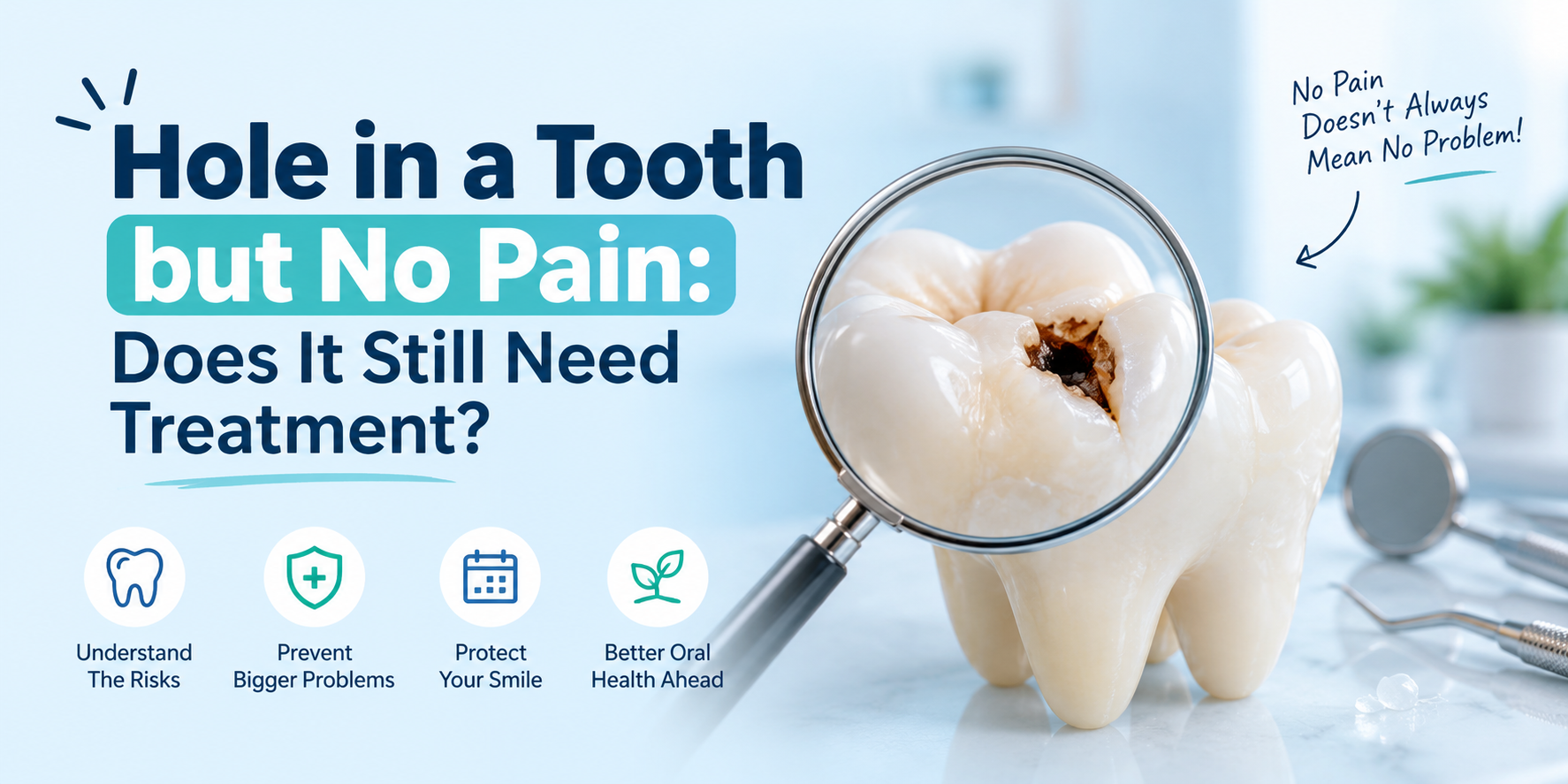

A hole in a tooth with no pain is one of the most misleading situations in dentistry. Many people assume no pain means no problem. That assumption is wrong. A cavity forms when bacteria and acid gradually eat through enamel – and enamel has no nerve endings. So in its early stages, tooth decay produces a visible hole in the tooth without producing any discomfort at all. According to the CDC, roughly 1 in 5 adults aged 20 to 64 has at least one untreated cavity right now. Most of those cavities are painless. That is exactly what makes them easy to ignore and risky to leave alone.
Key Takeaways
- A hole in tooth but no pain usually means decay is still in the outer enamel layer, which has no nerve supply.
- Approximately 91% of US adults aged 20 to 64 have experienced at least one cavity, according to national survey data.
- Pain is not a reliable early warning for tooth decay. Many cavities go undetected until they reach the deeper dentin or pulp layer.
- A cavity without pain can still progress into a root canal situation or abscess if left untreated.
- A dentist can detect a visible hole in tooth and early decay using X-rays, even when the patient feels nothing.
- Treatment is almost always simpler and less expensive when a cavity is caught early, before it causes pain.
Why a Hole in Your Tooth May Not Hurt
Tooth enamel is the hardest substance in the human body. It is also the only part of the tooth that contains no nerve fibres. When decay starts, it works from the outside in, through enamel first. At this stage, a hole in tooth no pain experience is entirely normal. There is nothing to hurt yet because the nerve has not been reached.
The nerve sits deep inside the tooth, in a chamber called the pulp. Once decay breaks through the enamel and reaches the dentin layer beneath it, sensitivity can start. When it reaches the pulp, pain usually follows – sometimes severe. But by that point, what was once a simple filling has often become a much more involved procedure.
There is a second reason a hole might be painless even in a more advanced case. If decay has progressed far enough to damage the nerve completely, the tooth can lose sensation entirely. A clinically documented outcome called pulp necrosis can leave a tooth feeling completely numb, even when serious internal damage has already occurred. Painless does not mean healthy in either of these scenarios.
What Causes a Hole in a Tooth?
A hole in tooth forms when acid produced by oral bacteria weakens and eventually breaks through the tooth’s enamel. The bacteria feed on sugars from food and drink, and the acid they release is what does the damage. Over time, this creates a pit, a groove, or a full cavity.
Several factors can speed up this process:
- Plaque buildup: Plaque is a sticky film of bacteria that clings to teeth. When it is not removed by brushing and flossing, it hardens into tartar and keeps bacteria close to the enamel surface.
- High-sugar diet: Frequent exposure to sugary or starchy foods gives bacteria more to feed on, producing more acid for longer periods.
- Dry mouth: Saliva naturally neutralises acid and washes away food particles. A reduction in saliva flow leaves teeth more vulnerable.
- Acid erosion: Acidic drinks such as carbonated sodas and fruit juices can erode enamel directly, even without bacteria. This is sometimes called tooth decay without pain because it progresses silently until enamel is thin enough to crack or pit.
- Teeth grinding (bruxism): Grinding wears down enamel over time, leaving teeth more exposed to decay.
- Deep grooves in back teeth: Molars have natural pits and fissures where bacteria accumulate. These are among the most common sites for a hole in tooth to develop unnoticed.
Signs of a Cavity You Can Spot Without Pain
Most people wait for pain before visiting the dentist. But there are several signs of a cavity that appear before any discomfort sets in. Knowing what to look for gives you a better chance of catching decay while treatment is still straightforward.
Discolouration on the Tooth Surface
One of the earliest signs of a cavity is a change in colour. A white chalky spot often signals that enamel is beginning to weaken. As decay progresses, it can turn brown or black. This discolouration is visible on the tooth surface and does not require any pain to be present.
A Visible Pit or Groove
A visible hole in tooth, whether on a biting surface, between teeth, or near the gumline, is a clear sign something is wrong. It may feel rough to the tongue. Food may catch in it repeatedly. Even if the area does not hurt, a pit like this means enamel has been breached.
Food Getting Trapped in the Same Spot
If food consistently gets stuck in one area, that is not a coincidence. It usually means a small cavity or structural change in the tooth is creating a space where food collects. This pattern is worth mentioning at your next general dentistry visit.
Persistent Bad Breath or Unusual Taste
Bacteria inside a decayed cavity release compounds that produce bad breath or a faint unpleasant taste. If this persists even after brushing and flossing, decay may be the reason, even in the absence of any soreness.
Sensitivity to Sweet Foods
Some people with early cavities notice a brief sharp feeling when eating something very sweet. This is not the same as the lingering temperature sensitivity seen with deeper decay. But it is a signal worth taking seriously. A preventive dentistry appointment is the right response.
Does a Cavity Always Hurt?
Does a cavity always hurt? No. In fact, according to the Cleveland Clinic, many cavities go undetected until they have already progressed significantly, because early decay often causes no symptoms at all. The Mayo Clinic similarly notes that cavity with no pain is a recognised and common presentation, particularly in the early and middle stages of decay.
Pain typically appears only when decay has broken through the enamel and is affecting dentin, or when it is close to or involving the pulp. By that point, the cavity is no longer small and easy to fix. This is why dentists recommend routine X-rays, not because they expect you to feel something, but because decay can be progressing without giving you any warning at all.
How Tooth Decay Progresses: Stage by Stage
| Stage | What Is Happening | Pain Level | Treatment Needed |
|---|---|---|---|
| Stage 1: Enamel demineralisation | Acid weakens the outer enamel; white spots appear | None | Fluoride treatment may reverse it |
| Stage 2: Enamel breakdown | A small hole forms in the enamel surface | None or very mild | Simple filling |
| Stage 3: Dentin involvement | Decay reaches the softer dentin layer beneath enamel | Sensitivity begins | Filling, possibly larger |
| Stage 4: Pulp involvement | Bacteria reach the nerve and blood vessels inside the tooth | Often significant pain | Root canal treatment |
| Stage 5: Abscess formation | Infection spreads beyond the root tip into surrounding tissue | Severe, sometimes with swelling | Root canal or extraction |
As the table shows, a cavity without pain sits in the first two stages. That is also where treatment is fastest and least invasive. Waiting for pain to appear means waiting until stage 3 or beyond.
What Happens If You Ignore a Painless Hole in Your Tooth?
Leaving a hole in tooth but no pain untreated is one of the more common dental mistakes. The cavity does not stay static. Bacteria continue to work, acid continues to erode the tooth, and decay moves steadily inward.
The consequences of delay include:
- Deeper decay reaching the nerve: Once the pulp is involved, a filling is no longer sufficient. Emergency dental care and root canal treatment become the likely next steps.
- Tooth abscess: An untreated infection can lead to a painful pocket of pus forming near the root. An abscess can spread to the jaw and surrounding tissue if not treated promptly.
- Tooth fracture: As decay hollows out more of the tooth structure, the remaining walls become fragile. The tooth may crack under the pressure of normal chewing.
- Tooth loss: When decay is too extensive to save the tooth, extraction is the remaining option. This creates a gap that affects surrounding teeth over time.
- Greater cost: A filling costs a fraction of a root canal and crown. Every stage of progression means a more complicated and more expensive procedure.
How a Dentist Diagnoses a Painless Cavity
A visible hole in tooth is not always obvious from the outside. Decay between teeth, below the gumline, or under an existing filling can be completely hidden. This is why a dental exam alone is not enough, and X-rays are essential.
During a general dentistry exam, your dentist will:
- Conduct a visual examination of all tooth surfaces using a mirror and light, looking for discolouration, pits, and soft spots.
- Use a dental explorer to check the texture of the enamel. Healthy enamel is smooth and hard. Early decay feels slightly sticky or rough.
- Take X-rays to identify decay between teeth and below the surface – areas that look completely fine during a visual check but may already have significant damage.
- Assess the depth of any cavities found, which determines whether a filling, crown, or root canal treatment is required.
One useful thing to know: early enamel damage is sometimes reversible with fluoride treatment. Catching a cavity at this stage means no drilling at all in some cases. That window only stays open if you come in before decay progresses further.
Treatment Options for a Hole in a Tooth
The right treatment depends on how far the decay has progressed by the time you see a dentist.
Dental Fillings
For a hole in tooth no pain situation caught in the enamel or early dentin stage, a filling is the standard approach. The decayed tissue is removed and the space is filled with composite resin or another material. This restores the tooth’s shape and stops further decay. At Lincolnwood Family Dental, tooth-coloured fillings blend seamlessly with the natural tooth.
Dental Crowns
When a cavity has weakened enough of the tooth structure that a filling would not hold, a dental crown caps the entire tooth. This is common for larger holes in back teeth. The in-house CEREC system at Lincolnwood Family Dental can produce a same-day ceramic crown – no temporary crown, no second appointment.
Root Canal Treatment
If decay has reached the pulp, a root canal is needed before the tooth can be restored. The infected nerve tissue is removed, the canals are cleaned and sealed, and a crown is placed over the tooth. Many patients find the procedure far less uncomfortable than they expected.
Fluoride Treatment
For very early decay that has not yet broken through the enamel, professional fluoride application can sometimes remineralise the weakened area. This is the one scenario where a hole in a tooth might not require a drill at all. It only applies to the earliest stage and requires prompt action before structural damage occurs.
When to See a Dentist About a Hole in Your Tooth
See a dentist promptly if you notice any of these:
- A pit, groove, or rough spot anywhere on a tooth surface
- Discolouration, white, brown, or black spots, on a tooth
- Food that consistently catches in the same spot
- A brief sharp sensation when eating something sweet
- Bad breath or an odd taste that persists after brushing
Do not wait for pain. By the time a cavity with no pain becomes a painful one, treatment has almost always become more complex. The most useful thing you can do for a painless hole is book a dental exam as soon as possible.
At Lincolnwood Family Dental, a women-led practice ranked number one in Lincolnwood for August 2025 with more than 700 five-star reviews, both routine cavity checks and same-day treatment options are available. Dr. Sana Baig and the team use digital X-rays to catch decay early, and the in-house CEREC system allows same-day crowns when needed. For patients dealing with a hole in tooth no pain situation, early evaluation is the right next step. Book an appointment online or call 847-610-9272.
FAQs About a Hole in a Tooth but No Pain
Can a hole in a tooth heal on its own?
No. Once enamel has broken down enough to form a visible hole, it cannot regenerate. The body cannot reverse a structural cavity. Very early enamel demineralisation, before a hole has actually formed, can sometimes be treated with fluoride. But a hole that is already present requires professional treatment to stop it from growing.
Does a cavity always hurt?
Does a cavity always hurt? No. This is one of the most common misconceptions in dental health. The outer enamel layer has no nerve supply, so decay in the early stages produces no pain. Many people discover they have a cavity only during a routine X-ray. Waiting for pain before visiting a dentist means waiting until the damage is already deeper and more complex to treat.
Is a hole in my tooth an emergency?
A small, painless hole in tooth but no pain is generally not a dental emergency, but it does require prompt attention. The longer it goes untreated, the greater the risk of it becoming one. If you notice pain, swelling, or a bad taste developing around the area, that moves it into urgent territory and same-day care is appropriate.
What does a cavity without pain look like?
A cavity without pain may appear as a white or chalky spot early on, then darken to brown or black as decay progresses. A visible hole in tooth (a small pit or rough area on the chewing surface or between teeth) is another common presentation. Some cavities between teeth are not visible to the naked eye at all and only show up on X-rays.
Can tooth decay without pain become serious?
Yes. Tooth decay without pain that is left untreated will eventually reach the dentin and pulp, causing pain, possible abscess, and in some cases tooth loss. The fact that it is painless now does not mean it will stay that way. The CDC notes that untreated cavities can lead to abscess, a severe infection that can spread to other parts of the body in rare cases. Early treatment remains the safest course.
This article is for general informational purposes only and is not a substitute for professional dental advice. If you notice a hole in a tooth or any of the signs of a cavity described above, see a dentist for a proper evaluation and treatment plan.